Why AI Portrait Booths Are Replacing Traditional Booths at SoCal Events
Introduction
Why AI Portrait Photo Booths Are Replacing Traditional Booths at SoCal Corporate Events comes down to more than novelty. Corporate planners increasingly need an activation that can create branded content, invite participation, support lead capture, and give guests something worth sharing after the event ends. A standard photo strip can still be charming. But for a product launch, employee summit, conference, or trade show, it may not create enough of a reason to stop, pose, and engage.
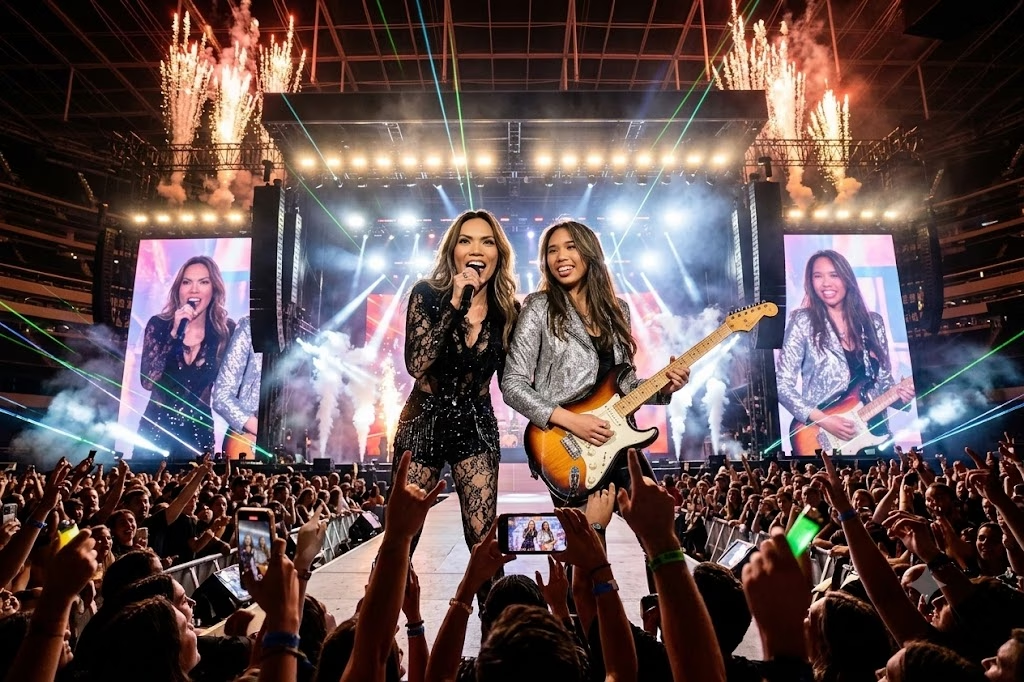
An AI portrait photo booth starts with a real guest photo and uses generative image processing to create a new visual treatment: an executive headshot, a cinematic campaign scene, a magazine-inspired portrait, or a brand-specific world. The underlying photo remains the source, but the final asset is designed to feel more intentional than a basic snapshot.
That shift matters in Southern California, where corporate events often compete for attention alongside polished venue design, entertainment, influencer content, and elaborate brand installations. The booth is no longer just a corner activity. It can become a compact content studio with measurable event goals.
TL;DR
AI portrait booths are replacing some traditional booths because they produce personalized, branded digital assets instead of only conventional photos. They can support engagement, content creation, and lead capture, but they are not automatically faster, cheaper, or better for every event. Your decision should depend on throughput, print needs, privacy controls, accessibility, and the business outcome you want to measure.
Table Of Contents
At A Glance
Why AI Portrait Booths Fit Corporate Objectives
They Turn a Photo Into a Campaign Asset
A traditional booth captures what happened. An AI portrait booth can interpret that moment through a campaign concept. That is the central difference.
For example, a cybersecurity company could build a futuristic command-center scene around each guest. A beauty brand could offer editorial-style portraits with colors drawn from a product launch. A media company could create stylized cover art that reflects a new series or franchise. The guest receives a personal image, while the organizer receives an asset that visibly belongs to the event.
This format works especially well when you need a clear connection between participation and brand recall. A logo in the corner of a print strip has limited storytelling power. A guest placed into a carefully designed visual world gives the branding a much larger role without requiring the guest to read a sales message.
For a closer explanation of the capture-to-rendering process, review How AI Photo Booths Work at Corporate Events. The important planning point is that the creative direction should be settled before event day. A strong result usually starts with approved visual references, brand colors, wardrobe considerations, and a narrow set of transformation styles.
Personalization Creates a Stronger Reason to Participate
Guests are more likely to engage when the reward feels made for them. AI portraits can make a participant look like the lead character in a cinematic scene, a polished editorial subject, or a future-facing professional. That personal stake can be more compelling than a generic backdrop.
This does not prove that every AI activation earns greater social reach. Independent benchmarks for social sharing, lead quality, and brand lift remain limited. Some providers market high share rates, but the available vendor claims do not consistently explain the event type, sample size, or denominator. Treat sharing as a measurable possibility, not a guaranteed outcome.
Instead, set a specific goal. At a trade show, you may want to convert passersby into completed captures. At an employee event, you may want broad participation across departments. At a product launch, you may want branded assets that attendees voluntarily save or share. Each goal calls for a different setup, call to action, and measurement plan.
AI booths as personalized, shareable content tools while noting that traditional booths still serve print-focused events and overflow needs. That is the more realistic framing: AI is often a format shift, not a universal replacement.
Brand Customization Has More Depth Than an Overlay
With a traditional booth, customization often centers on the backdrop, print template, prop selection, and digital frame. Those elements still matter. AI expands the design layer by allowing the generated environment itself to reflect the campaign.
A good corporate brief should define the following before development:
• Visual direction: Specify the approved aesthetic, such as editorial, retro-futurist, clean studio portrait, or illustrated product world.
• Brand elements: Identify logos, color values, products, approved slogans, and any visual elements that must not be altered.
• Guest treatment: Decide whether the output should preserve natural facial features closely or prioritize a more artistic transformation.
• Output format: Plan for vertical social images, square posts, headshots, print-ready files, or a combination.
• Distribution path: Choose QR delivery, text delivery, email delivery, a private gallery, or a lead-capture flow.
The distinction is worth reviewing in Differences Between Traditional and AI Photo Booths. AI delivers more creative control, but it also creates more decisions that cannot be improvised five minutes before doors open.

AI Is Not Always the Lower-Cost Choice
AI portrait booths can reduce some operational friction by using digital delivery rather than making every guest wait for a print. Yet the total cost may be higher than a basic traditional booth because the activation can require custom visual development, powerful capture hardware, processing capacity, a branded interface, technical support, and optional printing.
Think in terms of value per completed engagement rather than rental price alone. If a traditional booth costs less but produces a low percentage of branded, reusable assets, it may not meet the needs of a campaign-focused event. On the other hand, if the event is a casual holiday party where employees mainly want instant print strips, added AI production may not be necessary.
How AI Portrait Activations Work In Practice
The Workflow Is Simple for Guests but Complex Behind the Scenes
For guests, the experience should feel straightforward: pose, review, choose if needed, and receive the final image. Behind that simple interaction is a chain of tasks that needs to work reliably.
- Capture: A camera or device takes the source portrait under controlled lighting.
- Processing: Software identifies the portrait and applies the approved visual transformation.
- Quality check: The system or on-site team checks for obvious issues such as broken facial features, missing hands, distorted eyewear, or unreadable branding.
- Delivery: The finished image is sent by the selected digital method or routed to a printer.
- Measurement: The activation records agreed event metrics, such as captures, completed deliveries, opt-ins, or qualified leads.
The best activations make the guest-facing workflow short while giving the attendant a clear recovery path when processing slows or an output needs a retry. A booth that looks impressive but creates a long, uncertain queue can undermine the experience during a busy reception or trade show rush.
Plan Queue Throughput Before You Book
There is no universal, independently verified hourly throughput benchmark for AI portrait booths. Processing speed depends on the booth software, internet or local computing setup, selected style complexity, image resolution, retry rates, group size, and printer workflow. A provider should give event-specific estimates rather than a vague promise of “instant” results.
Ask for a peak-period model. If 180 guests are likely to arrive during the first hour of a gala, can the booth serve them without a 20-minute line? If the rendering time is longer than expected, can the guest leave their contact details and receive the portrait later? Is there a separate queue for retakes? Is a second station available?
Planning Factor | Traditional Booth | AI Portrait Booth | Decision Implication |
|---|---|---|---|
Primary output | Standard photo or print strip | Generated portrait or branded art | Choose AI when the visual transformation supports the event goal. |
Guest cycle | Often predictable | Can vary with rendering and retries | Model peak demand before committing to one station. |
Physical prints | Usually central | Often optional or added | Keep prints when tangible keepsakes are essential. |
Branding depth | Overlay, backdrop, props | Visual world, interface, output, delivery | Use AI for campaigns needing deeper creative integration. |
Operational risk | Printer, lighting, hardware | Hardware plus processing, delivery, and style consistency | Require a fallback plan for delays or failures. |
A practical recovery plan can include a static branded portrait option, a standard digital photo fallback, delayed gallery delivery, or a second traditional station. At a high-volume convention, a hybrid setup may serve guests better than forcing every attendee through one AI workflow.
Build Measurement Into the Activation
“People loved it” is useful feedback, but it is not enough for a corporate event budget decision. Define the event-performance metrics before the booth is designed.
Goal | Useful Metric | What It Reveals |
|---|---|---|
Attract attention | Queue conversion rate | The percentage of nearby visitors who begin the experience. |
Complete participation | Completed portraits per hour | Whether the setup can handle actual demand. |
Create usable content | Delivery completion rate | Whether guests successfully receive their assets. |
Capture leads | Voluntary opt-in rate | Whether the value exchange is clear enough for contact collection. |
Extend campaign reach | Shares or saved downloads | Post-event interest, when measured with a defined method. |
Improve future events | Retry and abandonment rate | Where instructions, lighting, or processing failed. |
For example, a conference sponsor may value qualified lead forms more than social sharing. In that case, do not bury the opt-in behind a long questionnaire. Let guests claim the portrait first, then present a separate, optional invitation to receive campaign communications. The booth should earn attention; the form should not interrupt it.
Choose Hybrid When the Event Has Two Jobs
AI does not need to displace every traditional booth. A hybrid activation is often the safer choice when your event needs both high-concept digital content and rapid physical keepsakes.
Consider a company anniversary gala. The AI station can create premium portraits for guests who want a shareable, polished asset. A traditional print booth can accommodate groups, provide immediate strips, and absorb traffic during cocktails. This arrangement protects the experience if rendering slows while preserving the novelty that makes the activation memorable.
An AI Portrait Booth Overview can help you evaluate whether a portrait-first setup fits your event creative. The decision is not “old versus new.” It is whether each station has a defined job.
How To Protect The Guest Experience And Your Brand
Protect Likeness, Inclusion, and Accessibility
A polished sample gallery does not guarantee identical results across all guests. Glasses, hats, textured hair, facial hair, mobility devices, reflective clothing, low lighting, and group poses can affect image quality. A heavily stylized treatment may also preserve less of a guest’s recognizable appearance than a natural headshot-style treatment.
Ask to review outputs that reflect realistic event conditions, not only ideal promotional examples. You should also define whether group portraits are supported, whether mobility devices will be represented respectfully, and what happens when a guest dislikes the first image.
Accessibility needs to be part of the floor plan, not an afterthought. Place the booth where wheelchair users can approach it easily. Keep the camera height adjustable or provide an alternative capture method. Use readable on-screen instructions, avoid relying only on audio cues, and ensure every guest can receive an equivalent-quality output. If a platform, line barrier, or screen is inaccessible, the activation is not serving the full audience.
Set Brand-Safety Boundaries Before Rendering Begins
Generative effects need boundaries. Your vendor agreement should spell out approved styles, prohibited themes, escalation contacts, and the process for removing any output that conflicts with the company’s standards.
This matters for regulated industries, employee events, public-facing activations, and brands with strict trademark or political-content rules. Avoid broad creative language such as “anything futuristic” if the event has sensitive requirements. Instead, approve reference imagery and specify exclusions: no weapons, no political symbols, no simulated medical claims, no suggestive imagery, no competitor marks, and no altered product packaging.
A small test session before the event can surface issues that a mood board cannot. Review the final output on the actual display and delivery format, then adjust the style before guests arrive.
Treat Privacy as a Design Requirement
A face image and a mobile number or email address can create a meaningful data-handling responsibility. Guests should understand that AI processing is occurring, how the image will be delivered, how long it will remain available, who can access the gallery, and whether the organizer plans to use images in marketing.
Recommends clearly disclosing processing, storage, gallery access, image use, deletion, and any data collection. It also advises keeping image delivery separate from marketing consent. That separation is practical: a guest can reasonably want their portrait without agreeing to future promotional messages.
Before the event, establish these responsibilities in writing:
• Data owner: Clarify whether the organizer, booth provider, or another platform controls participant information.
• Retention period: Set a specific timeframe for source photos, generated images, and contact details.
• Gallery access: Decide whether galleries are public, password-protected, event-only, or individually delivered.
• Deletion process: Provide a clear path for deletion requests and identify who responds.
• Model use: Confirm whether images are used to train models or are excluded from that purpose.
Digital delivery is common in this category. AI portraits may be delivered through QR codes or text messages. Whatever method you use, the delivery screen should communicate the privacy choices plainly rather than hiding them in a dense footer.
Key Takeaways
Make the Format Serve the Objective
• Choose AI portrait booths when you need a visually distinctive branded asset, a personalized guest reward, and a digital-first activation.
• Choose a traditional booth when instant prints, predictable group throughput, and familiar simplicity matter more than visual transformation.
• Choose a hybrid activation when your event needs both premium AI content and fast print-based overflow capacity.
• Measure results deliberately with captures per hour, completion rate, opt-in rate, delivery success, and defined sharing metrics.
• Require safeguards for accessibility, likeness quality, brand safety, consent, retention, and deletion before signing the agreement.
Frequently Asked Questions
What Is an AI Portrait Photo Booth?
An AI portrait photo booth captures a guest image and uses generative processing to create a themed, stylized, or professional-looking portrait. Unlike a conventional booth, its main value is the transformed output rather than only the original photograph.
How Does an AI Portrait Booth Differ From a Traditional Booth?
Traditional booths typically capture standard photos and may print strips immediately. AI portrait booths generate a new visual treatment based on the original photo, often emphasizing branded scenes, editorial looks, or digital sharing. They can require more processing time and planning.
How Many Guests Can an AI Booth Serve Per Hour?
It depends on rendering speed, retakes, group size, delivery method, and staffing. Ask your provider to estimate throughput for your guest count and peak arrival window, then request a fallback process if generation slows.
Can an AI Booth Use Our Logo and Campaign Theme?
Yes, when the provider supports custom visual development. Supply approved brand assets and define the intended style early. Review test outputs before the event so logos, colors, products, and visual tone are handled correctly.
Does an AI Portrait Booth Need a Physical Printer?
Not necessarily. Many AI portrait experiences are digital-first. Add printing if physical keepsakes are a priority, but account for printer capacity, paper supply, and the additional time required during peak demand.
What Privacy Language Should We Use for Guests?
Tell guests that AI processes the image, how they will receive it, how long it is retained, who can access it, whether contact details are collected, and whether marketing use is optional. Keep image delivery consent separate from marketing consent.
When Is a Traditional Booth the Better Choice?
A traditional booth may be better for a fast-moving employee party, a low-connectivity venue, a print-centered celebration, or an event where a predictable group-photo workflow matters more than stylized content. It is also a valuable backup station for large events.
Conclusion
Choose the Experience Your Event Can Support
AI portrait booths are gaining ground at SoCal corporate events because they can make each guest interaction feel more personal, more branded, and more useful after the event. Still, the strongest choice is not automatically the most technical one.
Choose AI when you can support thoughtful creative direction, transparent privacy practices, realistic queue planning, and measurable goals. Keep traditional printing in the mix when speed, predictability, and physical keepsakes carry equal weight. When those needs overlap, a hybrid activation can deliver both.
The right booth should do more than take a picture. It should give your guests a reason to participate and give your event team a clear way to evaluate what that participation achieved.
For those interested in aligning event activations with broader marketing industry standards, the American Marketing Association offers extensive resources on brand strategy and consumer engagement.