We Tried an AI Photo Booth at an Irvine Tech Party
Introduction
We Tried an AI Photo Booth at an Irvine Tech Party—Here’s Why Regular Photo Booths Are Dead is a deliberately provocative headline, but the underlying point is real: at a modern tech event, guests increasingly expect more than a four pose print strip and a bucket of plastic sunglasses.
A traditional booth captures a moment. An AI photo booth turns that moment into a small interactive experience. Guests choose a visual world, step into frame, watch a styled portrait appear, compare versions with friends, and send the result to their phones. The booth is no longer just a corner activity. It becomes a conversation engine.
That does not mean every regular booth is obsolete. A classic print booth still has a place at weddings, family celebrations, and events where instant physical keepsakes matter more than futuristic visuals. But for an Irvine corporate party, product launch, startup celebration, or employee event, the AI format can create a stronger reason for guests to participate, share, and return for another round.
Table Of Contents
• Why AI Booths Change The Event Experience
• What Actually Happens Inside An AI Photo Booth
• Privacy, Consent, And Facial Image Processing
• How To Plan An AI Booth For An Irvine Tech Party
• FAQ: AI Photo Booths At Irvine Events
TL;DR
AI photo booths can outperform regular booths at Irvine tech events because they create a repeatable interaction loop: choose a concept, capture a photo, receive an unexpected transformation, and share it instantly. The upgrade is worth considering when you have a clear theme, reliable connectivity, a privacy plan, and enough event time for guests to experiment. The catch: you need transparent consent, realistic throughput expectations, and a vendor that can explain exactly what happens to guest images.
Key Takeaways
• Choose AI when your event needs participation, branded content, and a visible technology moment rather than only printed souvenirs.
• Keep classic booths when the priority is fast group photos, tactile prints, low complexity, or minimal data handling.
• Separate consent choices for image generation, lead collection, and social sharing instead of hiding everything under one broad checkbox.
• Test the real venue connection before the event. A beautiful AI concept is less charming when rendering stalls behind a spinning wheel.
• Ask vendors whether they create faceprints or identify people. Artistic transformation and biometric identification are not the same operation.
Why AI Booths Change The Event Experience
The Old Booth Captures; The AI Booth Invites Play
A regular booth has a familiar rhythm: step in, pose, hear the countdown, collect the print, move on. It works because it is quick and low pressure. But the interaction often ends as soon as the shutter clicks.
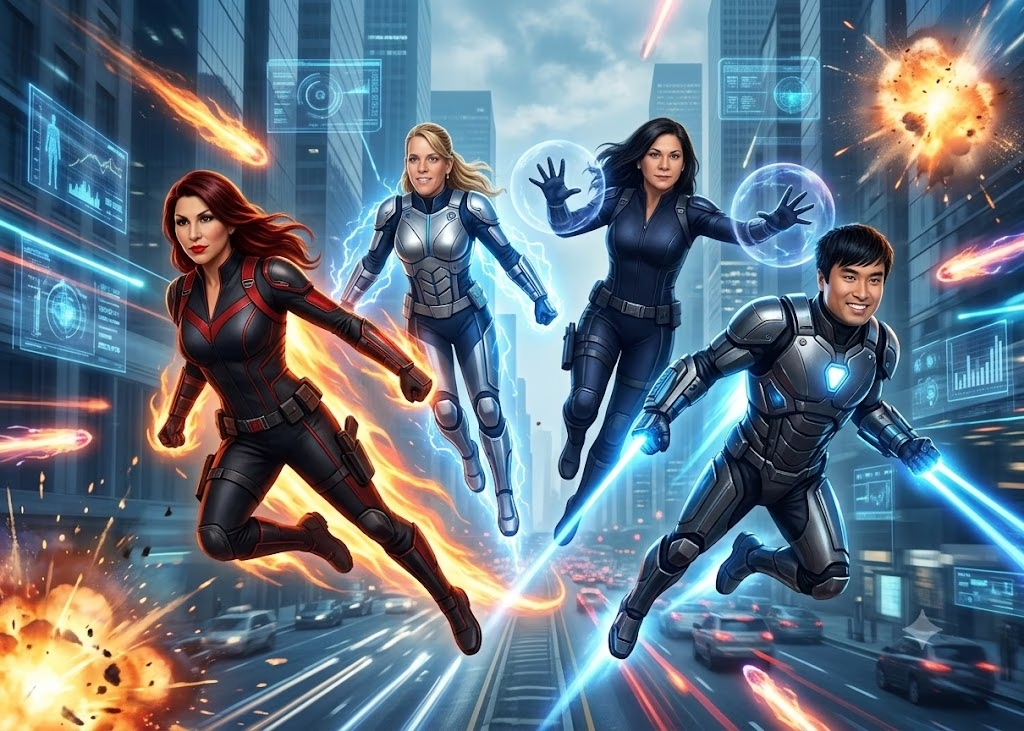
An AI photo booth adds a second act. Instead of merely documenting what guests wore to the party, it can place them in a retro arcade universe, turn a team into polished sci fi executives, or create a stylized magazine cover that fits the event theme. The surprise is not just the finished picture. It is seeing how the system interprets a real person inside an invented scene.
That changes the social behavior around the booth. People compare styles. Colleagues return with a different group. Someone who would skip a standard photo may try an AI portrait because the output feels less like a posed snapshot and more like a creative experiment.
For decision makers, this matters because engagement is not simply a line length metric. A long line can mean excitement, but it can also mean frustration. The useful measure is whether guests are voluntarily coming back, talking about the output, and sharing it after they leave.
There is no reliable Irvine specific benchmark proving that AI booths always produce more shares or more leads than standard booths. Vendors often make broad engagement claims, but results depend on the creative concept, guest mix, delivery method, and whether people actually want the image in their camera roll. A generic “AI astronaut” output may earn a polite smile. A concept tied closely to a product, team culture, or party theme is more likely to travel.
Why Regular Booths Can Feel Flat At Tech Events

At a software company celebration or conference after party, a plain booth can accidentally feel like a prop from another decade. Not because prints are bad, but because the experience offers little discovery. Guests already know what will happen before they step in.
AI introduces controlled unpredictability. The guest can choose a style, but the final rendering contains enough variation to feel fresh. That gap between expectation and result is where the fun lives.
Event Need | Traditional Booth Strength | AI Booth Strength | Best Choice |
|---|---|---|---|
Fast family group photos | Familiar, simple, predictable | Can struggle with complex group likenesses | Traditional booth |
Tech company party | Reliable social icebreaker | Interactive, themed, conversation worthy | AI booth |
Brand activation | Static overlays and prints | Branded visual worlds and multiple concepts | AI booth |
Formal wedding reception | Physical keepsakes and easy participation | Stylish portraits, but potentially slower | Depends on guest flow |
Privacy sensitive event | Minimal processing when capture is local | Requires clear image processing controls | Traditional or tightly governed AI |
For a more detailed side by side planning view, see AI Photo Booth vs Traditional Print Booth: Key Differences.
The Real Upgrade Is The Interaction Loop
The best AI booth setups are not just cameras with a novelty filter. They create a simple loop that guests understand in seconds:
- A guest sees a compelling visual example and understands the result before joining the line.
- They select from a limited number of polished styles rather than facing an overwhelming menu.
- The camera captures a well lit reference image.
- The system generates one or more transformed outputs.
- The guest retrieves the result through QR code, text, email, print, or a private gallery.
- A strong result gives the guest a reason to try a different style or bring friends back.
That last step is why regular booths can feel “dead” in comparison. The new format gives people a reason to repeat the activity. Still, more options are not automatically better. Six visually coherent styles may outperform 30 random choices. Too many buttons turn a fun booth into an airport kiosk with mood lighting.
What Actually Happens Inside An AI Photo Booth

From Camera Capture To Generated Portrait
An AI photo booth typically begins with a high quality camera capture, not a low resolution webcam snapshot. Lighting, camera angle, background separation, and pose guidance all affect the final output. If the source image is dim, blurry, or badly framed, the AI has less useful information to work with.
The software then uses the captured photo as a reference for a generative or transformative process. Depending on the platform, it may preserve facial characteristics while changing clothing, background, color palette, illustration style, or overall scene. Some systems create a single result; others produce multiple variations.
The key technical limitation is that AI does not always interpret details perfectly. Glasses can disappear. Fingers can become strange. A group of four may receive uneven styling. A guest wearing a lanyard might suddenly appear with an extra scarf, a cape, or a suspiciously ornate collar. That is part comedy, part quality control challenge.
A clear primer on the workflow is available in What is an AI Photo Booth and How It Works at Corporate Events.
Latency Is The Hidden Guest Experience Metric
Event planners often focus on the output image and overlook the wait between capture and delivery. That wait shapes everything.
If rendering takes only a short time, guests remain curious and attentive. If it takes much longer during peak arrival, the booth can become a bottleneck. A 90 minute party with 150 guests has very different throughput needs than a four hour open house where attendance naturally spreads out.
Before booking, ask the vendor to explain what happens during peak demand:
• How many guests can start a session at once?
• Does the system process images locally, through a cloud service, or through a hybrid workflow?
• What is the typical rendering range for a single person and for a group?
• What happens if venue Wi Fi weakens or cellular service is congested?
• Can the booth continue capturing if delivery is temporarily delayed?
Fair warning: “instant” is a marketing word, not a technical guarantee. A vendor should be comfortable discussing fallback plans, including local queues, cellular backup, an attendant managed line, and a conventional photo option if generation fails.
Branding Works Best When It Shapes The Scene
A logo in the corner is not the same thing as a branded experience. The stronger approach is to weave the brand into the visual concept without making every portrait look like an advertisement.
For example, a cybersecurity company could use refined “digital guardian” scenes with a consistent color system and subtle graphic motifs. A product launch could place guests in a stylized version of the product environment. A developer party could use playful retro computing, pixel art, or futuristic editorial portraits.
The decision rule is simple: if the branded concept still looks desirable in a guest’s personal photo library, it has a chance of being shared. If it looks like a slide from an internal presentation, guests may download it politely and never open it again.
Privacy, Consent, And Facial Image Processing
Artistic Transformation Is Not Automatically Facial Recognition
This is the most important distinction many event briefs miss. A booth can process a facial image to generate an artistic portrait without necessarily identifying a person or creating a reusable biometric template.
Under GDPR concepts, faces can become biometric data when they are processed for the purpose of uniquely identifying someone, a boundary explained in Upreach’s guidance on facial identification and photo booth compliance. In practical terms, a system that makes a faceprint and uses it to recognize or match someone across images carries a different compliance burden than one that transforms a submitted photo into a stylized image without identifying the individual.
Normal prints, GIFs, boomerangs, and 360 video are not biometric collection merely because a face appears in the image. The critical question is whether the system creates or uses a faceprint for identification.
That distinction does not eliminate privacy responsibilities. It gives you better questions to ask.
Build Consent Into The Booth, Not Into Fine Print
A sign near the booth is useful, but it is not a complete consent workflow when guests are asked to process facial images, provide contact details, or publish content.
A practical booth flow should work like this:
- A short pre capture screen explains that a photo will be used to generate an AI styled output.
- The guest taps an affirmative choice to proceed.
- Optional lead capture is separate from image generation consent.
- Optional permission for marketing use or public sharing is separate again.
- The guest can decline optional uses and still participate where the event design allows it.
Consent involving AI face matching should be explicit, informed, unambiguous, and based on a clear affirmative action. That principle is useful even when your booth is performing style transformation rather than identification: do not make guests guess what they are agreeing to.
PONS.ai similarly recommends that photo generation, lead capture, and social sharing have separate consent choices, along with clear retention and deletion.
Use A Specific Retention Rule
“Files may be retained as needed” is not a reassuring policy. You need a defined decision before the event begins.
A sensible structure separates files by purpose:
Data Type | Practical Purpose | Suggested Decision Rule |
|---|---|---|
Raw capture image | Generate the requested output | Delete after generation or after a short operational window unless a guest chooses gallery delivery |
Generated portrait | Deliver the event keepsake | Keep only for the stated gallery period, then delete |
Email or phone number | Send the guest’s output | Do not reuse for marketing without separate permission |
Lead data | Follow up after an activation | Retain under the company’s documented marketing policy and consent terms |
Faceprint or identification template | Recognition or matching | Avoid unless it is necessary, lawful, and supported by explicit controls |
A visible notice should tell guests what is captured, what output will be created, who receives files, and how long they remain available.
For an Irvine corporate event, a gallery available for about 30 days may be a reasonable operational starting point, but it is not a universal legal answer. If the event involves employees, minors, regulated industries, international attendees, or a system that performs identity matching, have the organization’s privacy and legal teams review the workflow before launch.
How To Plan An AI Booth For An Irvine Tech Party
Start With The Event Objective
Do not book an AI booth merely because the word “AI” appears in the event theme. Decide what success looks like.
If your objective is employee morale, prioritize fun styles, quick access, and a physical or digital takeaway. If your objective is lead generation, keep the creative output strong but make contact collection optional and transparent. If your objective is social content, invest in an image concept that guests would post without being asked twice.
For local planning considerations, including venue access, timing, and vendor questions, review Irvine AI Photo Booth Service: A Smarter Event Planning Guide.
Match The Booth To The Crowd
AI booths perform best when people have enough time to experiment. They are less ideal for a compressed 30 minute reception where every attendee must be processed quickly.
Choose an AI setup when:
• Your audience is comfortable using QR codes and touchscreen interfaces.
• The event has at least a modest dwell period, such as a cocktail hour, open house, networking block, or after party.
• You can offer a focused theme that fits the occasion.
• You have reliable power, a tested network plan, and enough space for a visible queue.
Choose a traditional booth when:
• You need rapid large group photos with little guest instruction.
• The audience values printed strips more than stylized digital portraits.
• The venue connection is unreliable and there is no dependable backup.
• Your organization wants the smallest possible facial image processing footprint.
A Vendor Checklist That Gets Past The Sales Demo

Ask these questions before signing:
- What exact data is captured, stored, transmitted, and deleted? Ask whether the system creates face templates, performs recognition, or only generates visual transformations.
- Where does processing occur? Cloud based rendering can be powerful, but it needs a clear connectivity and security explanation.
- What is the rendering plan during peak volume? Request a realistic throughput estimate for single guests and groups.
- Can guests opt out of marketing and still receive their image? If the answer is unclear, the consent design is not ready.
- What is the retention schedule? Get the timeline for raw images, generated images, galleries, and contact information in writing.
- What happens when the AI output is poor? A good vendor should offer regeneration options, pose guidance, or a fallback photo experience.
- Who manages the live experience? An experienced attendant can prevent queue confusion, guide guests, and handle small technical issues before they become a room wide problem.
The strongest vendor is not the one with the flashiest sample gallery. It is the one that can explain its process clearly, keep the interaction smooth, and make guests feel informed rather than processed.
FAQ: AI Photo Booths At Irvine Events
What Is An AI Photo Booth, And How Is It Different From A Regular Booth?
An AI photo booth uses a guest photo as the basis for a generated or transformed image. A regular booth captures standard photos, GIFs, or prints. The AI version adds a creative layer by changing the environment, aesthetic, wardrobe effect, or visual style.
Is An AI Photo Booth Better For Corporate Events?
Often, yes, when the event needs participation and memorable branded content. It is not automatically better for high volume events with short schedules, privacy restrictions, or guests who simply want quick printed photos.
Can An AI Booth Handle Groups?
It can, but group consistency is harder than single person rendering. Ask for examples that show groups of three to six people, not only polished individual portraits. If group shots are central to the event, keep a standard camera or print option available.
Do Guests Need To Consent Before Their Photos Are Processed?
They should receive a clear pre capture explanation and provide an affirmative opt in for AI image generation. Separate choices should be offered for lead capture, marketing use, and public sharing.
How Long Should Event Photos Be Kept?
Keep them only as long as needed for delivery and the stated event purpose. Many event galleries use a limited window such as around 30 days, but the right period depends on your policy, attendee expectations, and applicable privacy obligations.
What Happens If The AI Image Does Not Look Like The Guest?
The booth should allow a retry with better lighting, a clearer pose, or a different style. Poor likeness is a normal failure mode, especially with groups, reflective glasses, extreme poses, or complicated accessories. Set expectations that the output is an artistic interpretation, not an identity document.
Does An AI Photo Booth Need Wi Fi?
It may, depending on how the rendering platform works. Professional setups should include a connectivity plan that can use venue internet, cellular backup, local processing, or queued delivery. Never assume a venue’s guest Wi Fi is enough.
Conclusion
Regular photo booths are not truly dead. They remain excellent for simple, fast, tactile event photography. But at an Irvine tech party, an AI photo booth can offer something a standard booth rarely does: a reason for guests to linger, laugh, compare results, and come back with another group.
The best decision is not “AI versus traditional” in the abstract. It is whether the booth format matches your event objective, guest comfort level, privacy standards, and time constraints. Choose the experience that your guests will actually want to use, then make the consent and delivery workflow as polished as the pictures themselves.