AI Booth Sony Pictures Studios: What It Actually Refers To
Introduction
If you are searching for AI Booth Sony Pictures Studios, the most accurate answer is straightforward: there is no authoritative confirmation of a permanent public installation officially called an “AI Booth” at Sony Pictures Studios in Culver City.
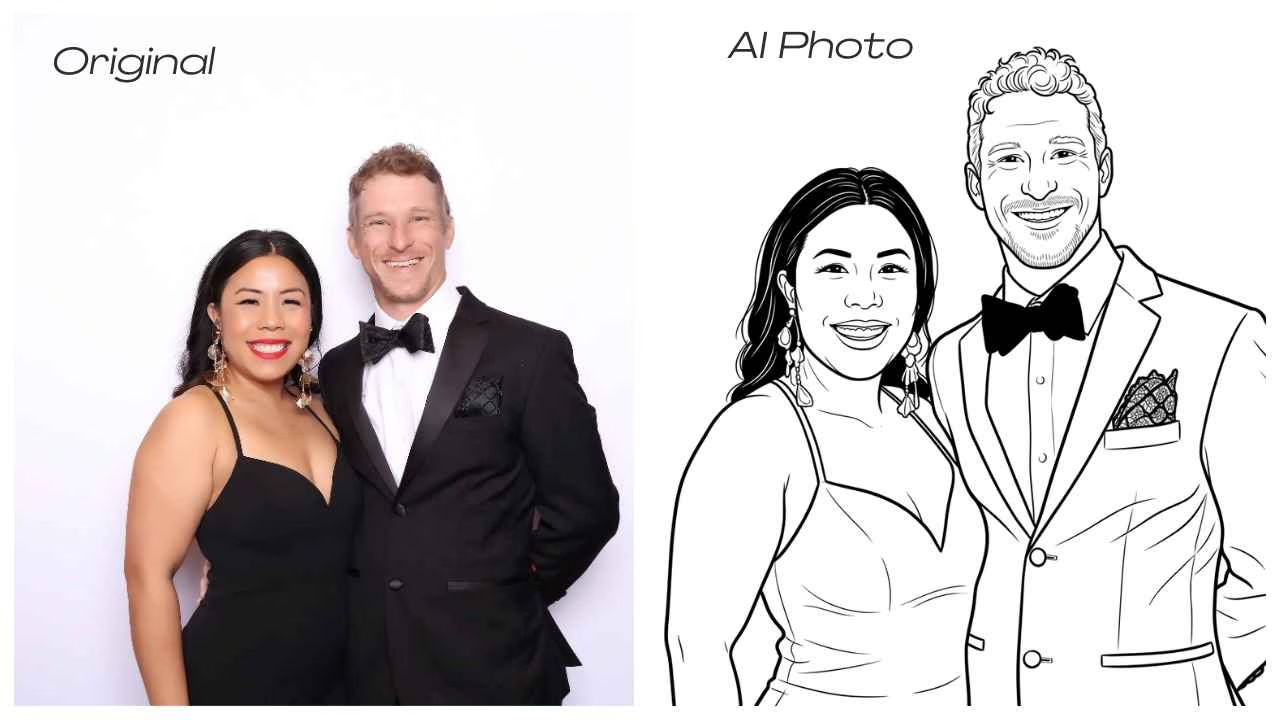
The phrase appears to combine several real but distinct ideas: AI film events held on the studio lot, Sony Corporation technology demonstrations, virtual production research, and the broader rise of AI driven brand activations in Los Angeles. That distinction matters. A temporary screening in a theater, a trade show demonstration, and a production facility can all involve AI, but they have different access rules, technical capabilities, and business purposes.
For decision makers, the useful question is not simply, “Where is the booth?” It is: _What type of AI experience are you trying to visit, evaluate, or build?_ Sony’s activity offers a useful case study because it spans experimental generative filmmaking, real time rendering, virtual environments, volumetric capture, and enterprise governance.
Table Of Contents
TL;DR
AI Booth Sony Pictures Studios is not confirmed as a permanent public exhibit. The strongest documented connection is an AI Cinema Screening held at the Sony Pictures lot on November 2, 2023. Sony also demonstrates AI, virtual production, real time 3D processing, and volumetric capture technologies through broader corporate and production initiatives. If you need to attend or produce an AI activation, verify the event organizer, venue entrance, registration status, and technology scope before making plans.
What The Phrase Usually Means
A Search Phrase, Not A Confirmed Permanent Attraction
“AI Booth Sony Pictures Studios” sounds like the name of a visitor attraction: walk up, take a photo, watch an AI transformation, and leave with a shareable asset. Yet the publicly available evidence does not establish a continuously operating booth at the studio under that title.
That does not mean the phrase is meaningless. It more likely reflects how several related experiences get grouped together in conversation:
• AI film screenings hosted at Sony Pictures Studios
• Sony corporate demonstrations involving machine learning, CGI, and virtual production
• AI portrait stations and branded content activations common at Southern California events
• Production technology used behind the scenes by studios, VFX teams, and creative departments
The difference is practical. A public facing portrait activation is designed for throughput, consent, branded sharing, and guest delight. A virtual production stage is designed for camera tracking, lighting continuity, real time rendering, and image quality. One may create an entertaining sixty second interaction; the other may shape a scene before a crew begins principal photography.
The Documented AI Cinema Screening
The clearest event connected to this search phrase was the AI Cinema Screening at Sony Pictures Studio, scheduled for November 2, 2023, at the Cary Grant Theatre on the studio lot. The program included generative AI films, filmmaker presentations, a Q&A session, ticketing requirements, and lot entry instructions. Its listed creative references included Stable Diffusion, Midjourney, ControlNet, synthetic audio, and DeepFaceLab related techniques.
That event is important, but it should not be mistaken for proof of a permanent Sony branded AI booth. It was a dated program with a specific venue and schedule. Think of it as a programmed gathering around AI filmmaking rather than an always available interactive installation.
For example, an executive who saw social posts from that evening might reasonably assume a public demonstration space exists on the lot. But arriving at the studio weeks later without a ticket, invitation, or event confirmation would be a poor plan. Studio lots are working production environments, not open exhibition halls.
Sony Pictures Studios Is The Venue, Not Every Technology Owner
Entity confusion is another reason this topic can become muddy. Sony Pictures Studios is the Culver City lot and production venue located at 10202 West Washington Boulevard in Culver City. Sony Corporation, Sony Group, Sony Pictures Entertainment, and Sony Pictures Imageworks have overlapping but different roles.
Entity | Primary Relevance To This Topic | What You Should Not Assume |
|---|---|---|
Sony Pictures Studios | Studio lot, production location, and event venue | Every Sony technology demo is installed there permanently |
Sony Corporation | Technology demonstrations and electronics innovation | Every corporate demo is available to studio visitors |
Sony Group | Enterprise research, production technology, AI governance | A research initiative is a bookable public service |
Sony Pictures Imageworks | VFX and animation expertise | Its workflows are automatically part of a specific event activation |
This separation helps you evaluate announcements correctly. If a Sony Corporation presentation showcases a new real time production workflow at an industry conference, it demonstrates a technology direction. It does not automatically announce a new public experience at the Sony Pictures lot.
From AI Film Experiments To Production Technology
Generative AI Demonstrations Serve A Different Purpose
The tools referenced by the 2023 screening point toward generative filmmaking experiments. Image generation, controlled image transformation, synthetic audio, and face related effects can be used for concept art, visual treatments, rapid prototyping, or short form film work.
These workflows can accelerate creative exploration, but they introduce constraints that a decision maker should take seriously. Generated imagery can vary unexpectedly from prompt to prompt. Character consistency may break between shots. A convincing still image may not translate into a production ready moving sequence. Rights, consent, asset provenance, and approval responsibilities can become more complex than the initial demo suggests.
That is why experimental AI filmmaking should be assessed differently from a campaign activation. In a brand activation, the priority is often a stable guest flow and a predictable output style. In filmmaking, the priority may be whether the result can survive editorial review, color finishing, VFX integration, and legal clearance.
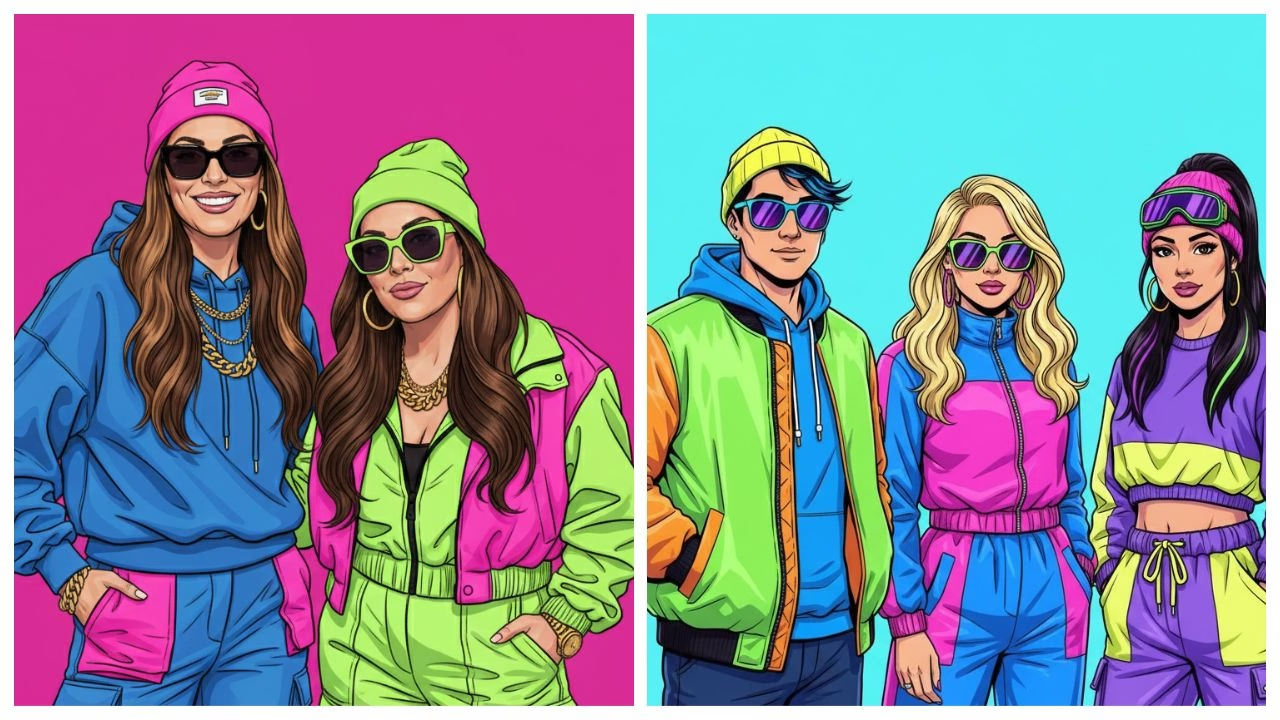
A controlled portrait activation might use an approved set of visual styles, selected wardrobe transformations, and fixed output framing. That limitation is a strength. It reduces the odds that a guest receives an off brand or unusable image. If you are evaluating an AI photo booth activation in Beverly Hills, that kind of guardrail is usually more valuable than unlimited prompt freedom.
Sony’s Technology Demonstrations Are Broader Than A Booth
Sony Corporation has publicly described virtual production demonstrations using Crystal LED displays and a photorealistic representation of the Sony Pictures studio lot. In that Sony technology demonstration overview, the background perspective changed in real time as the camera moved.
That capability illustrates the core logic of virtual production. A tracked camera continuously reports its position and lens perspective. A rendering system calculates the correct view of a virtual environment. The large display updates so the background appears to shift naturally behind performers. The goal is not merely to show a pretty backdrop. It is to give directors, cinematographers, and performers visual context while recording the shot.
Sony has also described deep learning work that estimates athlete posture and generates corresponding CG character movement. This is not necessarily tied to an AI booth or a particular Sony Pictures production. It does, however, show how machine learning can convert visual observations into animation related data.
What Production Ready Actually Means
A visually impressive demo becomes production ready only when it can support repeatable work under real constraints. That normally requires more than a model and a screen.
- Inputs must be reliable. Camera tracking, capture data, reference assets, and metadata need to remain accurate.
- Outputs must be controllable. Creative teams need predictable framing, approved styles, version control, and a clear way to reproduce a result.
- The system must fit the pipeline. Assets need to move from concept through editorial, VFX, sound, color, and delivery without creating disconnected files or unclear ownership.
- Rights decisions must be documented. The team needs clarity on the source material, performer permissions, licensed assets, and use of generated content.
- Failure recovery must be planned. If a render fails, tracking drifts, or a guest image is rejected, there should be a fallback path rather than an improvised scramble.
This is where many flashy demonstrations stop short. They show possibility, not operational maturity. That distinction is not a criticism. It is a useful filter for buyers deciding whether they need a spectacle, a pilot, or a production system.
How AI Fits Into The Filmmaking Pipeline
Pre Production: Simulation Before The Shoot
Sony Group’s 2024 Corporate Report describes Torchlight as a facility intended to simulate filming in a virtual space during the concept stage of motion picture creation. This kind of process moves decisions forward: teams can explore virtual camera positions, scene layouts, blocking, and digital environments before committing to a physical setup.
The strategic advantage is decision quality, not simply speed. If a director can see how a camera move interacts with a virtual environment early, the team can identify sightline problems or set scale issues before expensive production days begin.
For a brand experience, the same thinking applies at a smaller scale. Before approving an AI portrait booth, you can test the guest journey: Where does the queue begin? How does the operator explain consent? How long does an image generation cycle take? What happens when a generated face does not resemble the participant? A short technical rehearsal often reveals more than a polished pitch deck.
Production: Real Time Rendering And Virtual Environments
During production, virtual production combines physical performance with a digitally rendered environment. The workflow typically includes a tracked camera, rendering engine, calibrated display, lighting coordination, and careful synchronization between departments.
The creative benefit is immediate feedback. Instead of asking a performer to imagine a distant city or fictional interior against a blank screen, the performer can react to a visible environment. The cinematographer can also evaluate the relationship between lens choice, foreground props, lighting, and the background in camera.
The tradeoff is complexity. A virtual environment must be designed for the intended camera range, display resolution, lighting conditions, and shot design. If the camera moves outside planned parameters, the illusion may weaken. If the content is not optimized, real time frame rates can drop. AI may assist with asset preparation or variation, but it does not remove the need for skilled art direction and technical supervision.
Post Production: Capture, Processing, And Iteration
Sony’s 2024 Corporate Report on production technology describes work involving sensing and capturing, real time 3D processing, AI, machine learning, and a Volumetric Capture Studio that generates three dimensional data from people and locations. It also references a proof of concept short film that used Pictures segment assets to test real time image production with a game engine.
Volumetric capture differs from a standard video recording. Rather than capturing only a flat view from one camera angle, a multi camera process can create spatial data that supports a more flexible representation of a person or location. That data can be processed into a 3D asset for virtual camera work, immersive media, or certain visual effects workflows.
Still, volumetric capture is not a shortcut for every project. It can require controlled capture conditions, substantial processing, and careful cleanup. It is most valuable when the ability to change viewpoint or integrate a real performance into a 3D environment justifies the complexity.
For event marketers, a lighter weight version may be more appropriate. An AI photo booth for trade shows and brand events can offer branded AI transformations without pretending to be a full volumetric stage. Matching the technology to the audience goal protects both budget and guest expectations.
Access, Verification, And Event Planning
Confirm The Event Before You Travel
The most dependable approach is to treat Sony Pictures Studios access as event specific. A studio address is not an invitation, and a past program is not a current schedule.
Before arranging travel, vendor delivery, executive attendance, or client invitations, confirm these items directly with the named organizer:
• Event date and start time
• Exact building, theater, gate, or check in location
• Ticket, registration, invitation, or credential requirements
• Parking instructions and arrival window
• Prohibited equipment and security restrictions
• Whether photography, recording, or social posting is permitted
• Accessibility accommodations and guest support contact
Fair warning: generic venue information cannot answer all of these questions. A screening may use one gate and security process, while a private industry event may use another. Do not rely on a previous event page as proof of current access.
How To Evaluate A Proposed AI Booth
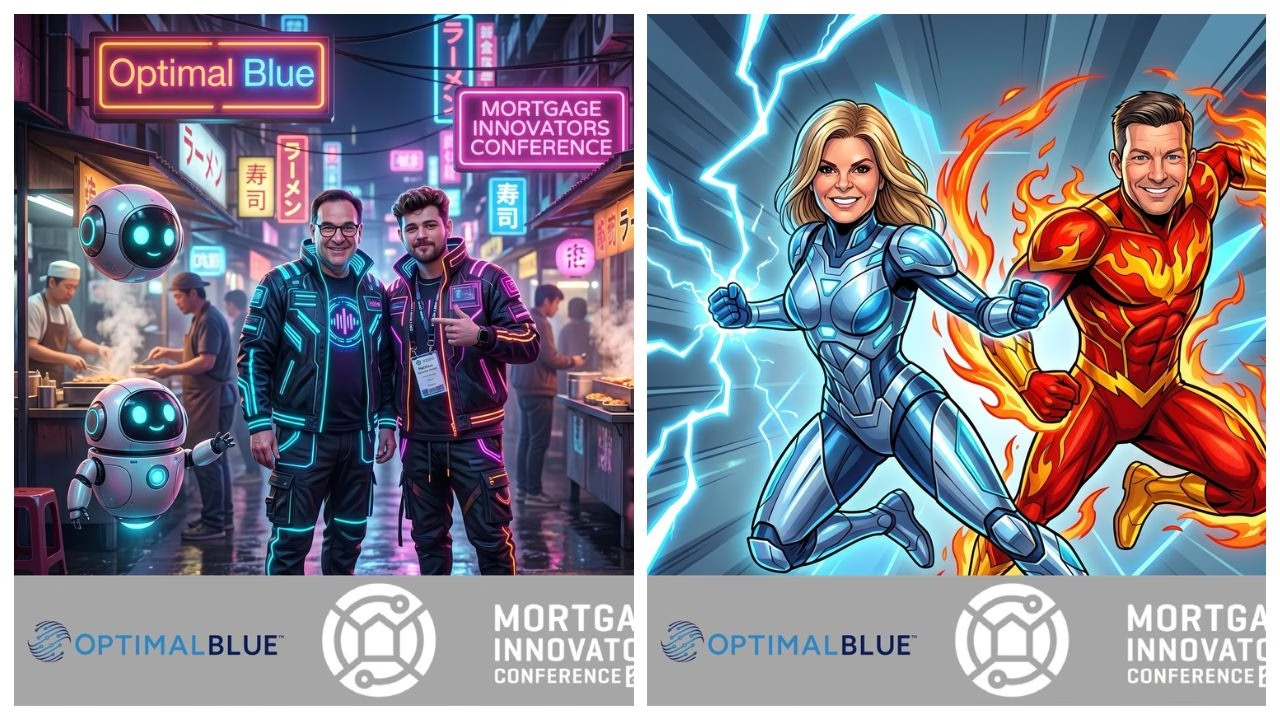
If your actual objective is to commission an AI experience inspired by studio technology, start with the business outcome. “We want AI” is not yet a production brief.
Goal | Better Experience Design | Key Decision Criterion |
|---|---|---|
Generate social sharing | AI portrait or avatar station | Output must be fast, polished, and easy to share |
Drive trade show leads | Branded AI experience with consent flow | Data capture must be transparent and optional where required |
Entertain gala guests | Curated visual transformations | Brand controls and operator support matter more than open prompts |
Explore film concepts | Virtual previs or generative look development | Repeatable asset control matters more than public throughput |
Create immersive content | Volumetric or real time 3D workflow | Capture quality and post processing resources must justify the cost |
A useful briefing sequence is simple:
- Define the audience moment you want to create.
- Decide what guests receive: print, digital image, short video, avatar, or lead follow up.
- Set nonnegotiables for brand safety, likeness consent, accessibility, and turnaround time.
- Test the system with realistic lighting, connectivity, and guest volume.
- Prepare a fallback experience if generation is delayed or unavailable.
The fallback is often overlooked. If an AI rendering queue slows during a peak arrival window, a well designed experience may switch temporarily to a high quality branded photo capture rather than leaving guests waiting. That is operational resilience, not a downgrade.
For practical procurement questions, a Smart planning guide for AI photo booth rentals can help you frame the scope before comparing vendors.
Rights, Consent, And Governance Need More Than A Badge
Sony Group states that its AI governance work includes an AI Ethics Committee and AI risk assessments at the group company level. The corporate report also addresses creator rights concerns. That is meaningful evidence of enterprise level attention to AI risk, but it does not disclose booth specific terms for a hypothetical current Sony Pictures Studios installation.
If you are planning your own activation, make the operational questions concrete:
• Are participant images retained, deleted, or used for analytics?
• Can participants decline AI processing while still receiving a conventional photo?
• Are prompts, styles, and generated outputs reviewed for brand suitability?
• Who has approval authority if a likeness, trademark, or cultural representation concern arises?
• What content is delivered to guests, and what remains in vendor systems?
A consent screen alone is not enough if its language is vague or if guests feel pressured to participate. Clear choice, a visible operator, and an alternative experience are often the more trustworthy design.
FAQ
What Is The AI Booth At Sony Pictures Studios?
No authoritative source confirms a permanent installation officially named “AI Booth Sony Pictures Studios.” The phrase is best understood as an umbrella search term for AI related screenings, Sony technology demonstrations, and potential event activations associated with the studio or broader Sony ecosystem.
Was The AI Cinema Screening An Official Permanent Sony Booth?
No. The documented November 2, 2023 event was a scheduled AI film screening at the Cary Grant Theatre. Its listing does not establish that a permanent public booth operated before or after the event.
Is Sony Pictures Studios Open To The Public For AI Exhibits?
You should assume access is event specific. Confirm registration, guest list status, entrance procedures, and parking instructions with the current event organizer before visiting.
Which AI Tools Were Referenced At The 2023 Screening?
The event listing referenced Stable Diffusion, Midjourney, ControlNet, synthetic audio, and DeepFaceLab related techniques. Those references describe the program’s generative filmmaking focus, not necessarily Sony owned production tools or permanent installations.
What Is The Difference Between An AI Booth And Virtual Production?
An AI booth typically creates a quick guest facing output, such as a portrait or avatar. Virtual production supports filmmaking through tracked cameras, real time rendered environments, display systems, and production pipeline integration. The first is optimized for interaction; the second is optimized for controlled image creation.
Can Filmmakers Access Sony’s Virtual Production Or Volumetric Facilities?
Public materials describe Sony’s technology direction, including virtual filming simulation and volumetric capture. They do not, by themselves, establish public booking access, prices, or availability. Contact the relevant Sony organization or event producer for current service details.
How Can You Verify A Current AI Event At The Studio?
Look for a current organizer announcement, a registration page, and direct venue confirmation. Check the event date, theater or building, entry gate, parking plan, and credential requirements. A past listing should be treated as historical context, not a live invitation.
Key Takeaways
The Most Useful Decision Framework
If you are evaluating AI Booth Sony Pictures Studios for attendance, research, or activation planning, separate the question into three layers:
• Venue: Sony Pictures Studios is a working Culver City studio lot with event specific access procedures.
• Program: The 2023 AI Cinema Screening is a verified past event, not evidence of a permanent public booth.
• Technology: Sony’s broader work includes virtual production, machine learning, real time 3D processing, game engine workflows, and volumetric capture, each suited to different production goals.
Choose The Right Level Of Technology
Use a guest facing AI portrait, illustration, avatar, or drawing experience when you need engagement at a corporate gala, hotel event, convention, or brand pop up. Use virtual production or volumetric capture only when your creative objective requires spatial control, cinematic flexibility, or 3D asset generation.
The most impressive technology is not always the most effective choice. A stable, branded, well staffed activation can outperform a technically ambitious concept if the latter creates long wait times, inconsistent output, or unclear consent.
Conclusion
AI Booth Sony Pictures Studios is best approached as a question of context, not a single confirmed destination. The documented AI Cinema Screening demonstrates real interest in generative filmmaking on the Sony Pictures lot, while Sony’s wider technology work shows how AI, virtual environments, capture systems, and real time rendering may reshape the production pipeline.
If you are planning an AI activation, begin with the guest outcome and operational constraints. If you are trying to attend an event, verify the current organizer details before traveling. That combination of creative ambition and practical confirmation is what turns AI from a vague attraction into a reliable experience.
Ultimately, the confusion surrounding the AI Booth Sony Pictures Studios highlights how quickly industry buzz outpaces physical reality. While you won’t find a permanent AI Booth Sony Pictures Studios, the interest in an AI Booth Sony Pictures Studios proves that creators are hungry for innovation. If you seek an AI Booth Sony Pictures Studios experience, focus on industry-specific trade shows rather than a non-existent AI Booth Sony Pictures Studios on the lot. Don’t let the myth of an AI Booth Sony Pictures Studios distract you from real production tools. Whether you need an AI Booth Sony Pictures Studios for research or an AI Booth Sony Pictures Studios for networking, verify your sources first. An AI Booth Sony Pictures Studios is not a standard tour feature, so avoid planning an AI Booth Sony Pictures Studios visit without a formal invite. Even if an AI Booth Sony Pictures Studios appears at a future gala, an AI Booth Sony Pictures Studios remains a temporary fixture. Treat every AI Booth Sony Pictures Studios claim with skepticism, as no official AI Booth Sony Pictures Studios currently operates for the public.