Next-gen AI Lab for Corporate Retreats
Introduction
A Next-gen AI Lab for Corporate Retreats is not a keynote with a few tool demonstrations attached. It is a focused offsite where your team tests artificial intelligence against real business decisions, workflows, and customer needs, then leaves with a clear set of owners, safeguards, and next steps.
The distinction matters. A retreat can create energy quickly, but energy alone rarely changes how work gets done. A well designed AI lab turns limited offsite time into something more durable: prioritized use cases, tested prototypes, shared AI literacy, governance decisions, and a practical 30 day adoption plan.
TL;DR: Build your retreat around measurable outputs, not novelty. Use real but protected business scenarios, separate experimentation from production systems, include leaders who can make decisions, and assign owners before everyone leaves the venue.
Table Of Contents
- What Makes An AI Lab Different
- Designing The Right Retreat Format
- Building Workflows, Prototypes, And Team Alignment
- Protecting Data And Creating Responsible AI Guardrails
- Key Takeaways
- Frequently Asked Questions
- Conclusion
Why Decision Makers Need A Lab, Not A Demo
For decision makers, the core question is simple: _What should be different on Monday morning?_ If the answer is only that employees feel inspired, the retreat may have been enjoyable but incomplete.
An AI lab creates a controlled setting for choices that are often difficult to make in regular meetings. You can compare possible use cases, see where data limitations appear, determine whether human approval is required, and decide what deserves investment. A marketing team might test a structured content review workflow. An operations team might map intake, classification, and escalation steps. An executive group might decide which functions can experiment now and which need further risk review.
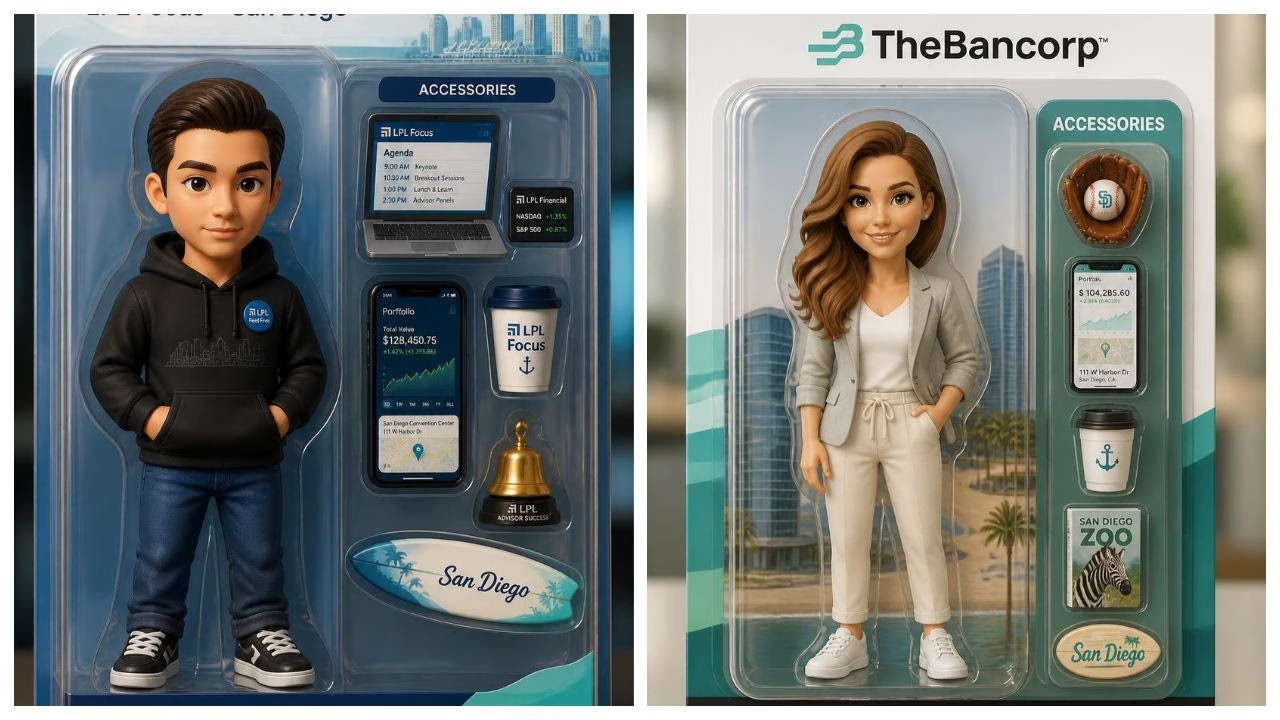
This approach also makes room for experiential elements without confusing entertainment with implementation. For example, an AI portrait station can help participants understand how generative models interpret visual inputs, brand direction, and creative constraints. A branded experience such as a Next-gen AI Photo Lab for Los Angeles Tech Conferences can complement a retreat by making the technology tangible. It should not, however, substitute for a business workflow lab.
Key Takeaways
• Treat the retreat as a decision and design sprint, not a general AI presentation.
• Define success before selecting activities: validated use cases, prototype evidence, policy decisions, or approved implementation plans.
• Match the format to participant authority, AI maturity, and the sensitivity of the data involved.
• Use a sandbox, redacted materials, or synthetic data for hands on work whenever confidential information is involved.
• Give every post retreat initiative an executive sponsor, operational owner, review date, and measurable outcome.
What Makes An AI Lab Different
A Retreat With Acceptance Criteria
A conventional workshop often aims to teach concepts. A conference aims to expose attendees to ideas and contacts. An AI lab is more demanding because it should produce artifacts that can be evaluated.
Before choosing a venue, facilitator, or technology, set acceptance criteria. The exact criteria depend on your goal, but they should be observable. Examples include:
Retreat Objective | Useful Output | Acceptance Question |
|---|---|---|
Executive alignment | Ranked AI opportunity portfolio | Did leaders agree on what will and will not be pursued this quarter? |
Team capability | Role specific workflow playbooks | Can participants repeat the workflow with defined quality checks? |
Process improvement | Tested prototype or process map | Did the team document inputs, outputs, reviewer steps, and failure points? |
Governance | Approved experimentation rules | Are data classifications, allowed tools, and escalation paths explicit? |
Innovation | Shortlisted concepts | Did each idea receive a value, feasibility, and risk assessment? |
This is not unnecessary bureaucracy. It protects the retreat from a common failure mode: producing a wall of sticky notes with no decision behind it. A team may generate 40 ideas in an afternoon, yet only two may have clean enough data, available owners, and manageable risk to move forward.
One Off Offsite Or Ongoing Research Relationship
The phrase “AI lab” can also mean a longer term relationship with a research organization rather than a single corporate retreat. Stanford’s AI Lab Affiliates Program describes organized retreats, conferences, and ongoing interaction between industry and the AI laboratory. That model is materially different from a private two day offsite.
Its corporate overview further describes retreats, focus groups, hosted visits, research interaction, and corporate membership terms through a defined program structure in the Stanford AI Lab corporate overview. For some organizations, especially those pursuing longer horizon research questions, continuing engagement may be more useful than a single retreat.
Choose a standalone lab when you need alignment and near term implementation. Consider a sustained research model when your questions concern emerging methods, strategic partnerships, or research topics that cannot be resolved through a short internal sprint.
When Immersive Experiences Add Value
Immersive experiences work best when they reinforce the retreat’s central learning goal. A visual generative AI experience can show participants how inputs, style instructions, constraints, and approvals affect output. That makes abstract topics such as prompt design and brand control easier to discuss.
There is a limit. If your central challenge is automating complex procurement review, a cinematic image generator is not proof that the workflow is safe or useful. Use experiential technology to build curiosity and participation, then move the group toward the actual process, data, and accountability questions.
Designing The Right Retreat Format
Start With A Capability And Data Readiness Assessment
Do not assume everyone needs the same retreat. A leadership group deciding where to invest needs a different design from a customer support team learning how to draft knowledge base responses.
A short pre retreat assessment can reveal the right level of depth. Ask participants and sponsors about:
• Existing AI tool access and approved platforms
• Familiarity with generative AI, automation, data analysis, and prompt design
• Repetitive work that consumes time or introduces avoidable delays
• Data classifications involved in candidate workflows
• Decisions leaders are prepared to make during the retreat
• Constraints from legal, security, compliance, brand, or labor policies
The assessment should expose disagreement early. Consider a sales leader who wants a personalized proposal assistant, while legal has not approved use of customer contract data in third party systems. The lab can still explore the workflow, but it should use a synthetic account record or approved redacted material. That changes the goal from “deploy this now” to “validate the process and identify the controls required for a pilot.”
Match The Audience To The Outcome
Group size has no universal standard, and available evidence on ideal attendance is limited. Still, smaller working groups tend to make deeper decisions, while larger groups can be effective for orientation and shared experience.
Audience | Best Fit | Avoid When |
|---|---|---|
Executive team | Strategic choices, investment priorities, governance thresholds | You need detailed process mapping from frontline roles |
Cross functional leaders | Use case prioritization and operating model design | Participants lack authority to commit resources |
Functional team | Workflow redesign, role based practice, prototype testing | The process depends on another department that is absent |
Large all hands group | AI literacy and visible engagement | You expect production ready prototypes by the end |
A practical hybrid structure often works well: begin with shared context, divide into functional pods, then reconvene for pitch style review and decision making. This preserves a common language without forcing finance, creative, operations, and legal teams through identical exercises.
For a reference point, the Creative AI Workflow Offsite from Driftawave is advertised as a 1.5 to 2 day program for roughly 15 to 40 people and uses real creative work to develop workflows. That model supports a useful principle: use genuine work briefs, not generic examples, when the team has permission and safe materials to do so.
Choose Tools By Workflow, Not Hype
Do not require every participant to use the same AI platform simply because it is convenient. Different tasks call for different capabilities, and your approved technology environment may limit options.
A useful tool decision asks four questions:
- What job is the tool helping complete? Drafting copy, summarizing approved notes, analyzing structured data, producing images, or automating handoffs are different jobs.
- What information will it receive? Classify the input before selecting the tool.
- Who reviews the output? A human in the loop should be explicit for consequential content, external communications, or decisions affecting people.
- Can the process be repeated? If participants cannot explain the inputs, checks, and handoff steps, the result is a demonstration rather than a workflow.
If you are evaluating visual engagement vendors as part of a wider retreat or corporate event plan, Comparing 5 AI Photo Booth Companies for a Corporate Tech Conference can help frame the experience layer separately from the internal workflow and governance layer.

Building Workflows, Prototypes, And Team Alignment
A Practical Lab Sequence
A productive lab usually needs enough time for discovery, testing, and commitment. Two days may be sufficient for a focused group with clear business problems. Three days can be more appropriate when multiple functions must design processes and resolve governance questions.
A published format from MaxICo Labs’ AI retreat structure describes a two to three day approach that includes data hygiene, role based work, AI processes, and a short term integration plan. The important lesson is not that every retreat must follow that schedule. It is that integration planning belongs in the core design, not the final ten minutes.
A sequence worth adapting looks like this:
- Frame the decision. Define the business problem, target users, constraints, and what success would look like.
- Map the current workflow. Identify where work begins, where data enters, who approves it, and where delays or quality failures occur.
- Design the AI assisted workflow. Specify model inputs, output format, human review, exception handling, and required records.
- Test in a sandbox. Use approved sample materials, synthetic data, or redacted examples. Capture where the model fails, fabricates details, misses context, or produces unusable output.
- Prioritize and commit. Assign a sponsor, process owner, technical owner, risk reviewer, and target date.

Treat Prototypes As Evidence, Not Finished Products
A retreat prototype proves only a narrow point. It may show that an AI assistant can turn a standardized brief into a first draft. It does not prove that the system is accurate enough for customer use, integrated with company systems, secure, monitored, or legally approved.
That distinction helps teams avoid premature deployment. A prototype that fails can still be valuable if it reveals why. Perhaps source documents are inconsistent. Perhaps the workflow requires too much judgment to automate. Perhaps the model can assist a reviewer but should not produce final output independently.
Fair warning: a “successful” prototype can also hide a problem. If it only works because one highly skilled participant knows the exact instructions, it is not yet an operational capability. Ask another participant to repeat the process from the documented workflow. If results vary sharply, invest in templates, standards, training, or a narrower scope.
Build The Adoption Mechanism Before Departure
The period after the retreat determines whether the lab becomes a working program or a good memory. Each selected initiative should have a concise adoption card with:
• A named executive sponsor who can remove barriers
• An operational owner accountable for the workflow
• A defined user group for a limited pilot
• A metric tied to the original problem, such as cycle time, quality review rate, or completion rate
• A review cadence, often at 15 and 30 days
• A stop condition if risk, quality, or cost exceeds the agreed threshold
Avoid measuring value only through number of prompts, images, or tool logins. Those show activity, not business impact. A content workflow, for example, might measure time to first draft and editor revision rates together. Faster drafting is not a win if revisions rise sharply.
Protecting Data And Creating Responsible AI Guardrails
Separate Experimentation From Production
A retreat is an especially poor place to connect untested tools directly to production systems. Participants are moving quickly, experimenting broadly, and often working outside normal operational routines.
Use a sandbox environment with limited access, approved accounts, and clear logging where possible. Keep experimentation separate from customer facing databases, financial systems, and live communications channels. The retreat should produce a controlled test, not an accidental deployment.
This separation also makes experimentation safer for regulated industries. A healthcare, financial services, legal, or public sector team may still explore process design, but it should start with synthetic scenarios, de identified examples, and compliance review. The goal may be a pilot design rather than a functional model.
Give Participants Simple Data Rules
Data hygiene should be visible from the first session, not buried in a closing slide. Before any hands on activity, provide a plain language decision rule:
Data Type | Retreat Handling |
|---|---|
Public material | Use only in approved tools and within brand guidelines |
Internal non sensitive material | Use when policy allows and access is controlled |
Confidential business information | Redact, summarize, or use within an approved private environment |
Personal, regulated, or highly sensitive data | Do not use unless specifically authorized through established controls |
Participants also need a clear escalation route. If someone is unsure whether a document can be used, the default should be to pause and substitute a safe example. That may feel slower in the moment, but it prevents the retreat from becoming the source of a data exposure.
Define Human Accountability
AI governance is not only about what tools are permitted. It defines who remains responsible when AI contributes to a workflow.
For each use case, identify the human reviewer, approval authority, and exception path. In a recruiting scenario, AI might help summarize interview notes, but the hiring decision must remain with authorized people using approved criteria. In a customer service scenario, AI may draft a response, while a trained employee approves messages involving refunds, legal concerns, safety, or account access.
Thoughtful event design can also make these principles approachable. Creative installations and collaboration challenges can help teams discuss consent, brand representation, and review standards in concrete terms. For more ideas on connecting participation to responsible experience design, explore Transform Your Event with AI.

Frequently Asked Questions
What Is A Next-gen AI Lab For A Corporate Retreat?
It is an offsite working environment where your team learns, tests, and prioritizes AI enabled workflows around defined business goals. Unlike a general presentation, it should produce decisions, documented experiments, prototypes, or implementation plans.
How Is An AI Lab Different From A Normal AI Workshop Or Conference?
A workshop usually emphasizes instruction. A conference emphasizes exposure to speakers and peers. An AI lab emphasizes application: your team brings business problems, tests possible workflows, identifies controls, and decides what happens next.
Who Should Attend An AI Focused Corporate Retreat?
Include the people who understand the work, own the process, manage the technology, and can approve change. For a high priority workflow, that often means a business leader, frontline subject matter expert, IT or data representative, and risk or legal stakeholder. Avoid filling the room only with senior leaders if implementation depends on absent operators.
How Long Should A Corporate AI Retreat Last?
A focused strategic or workflow lab can often fit into one and a half to two days. Complex cross functional work may need two to three days. Duration should follow the output: a leadership alignment session needs less time than multiple prototype tests with governance review.
How Can We Use Real Company Problems Without Exposing Confidential Data?
Use redacted documents, synthetic data, sanitized scenarios, or an approved private environment. Map the real workflow, but do not assume real data must be uploaded for the exercise to be useful. If a test requires sensitive records, pause until the appropriate controls and approvals are in place.
Should Every Participant Use The Same AI Platform?
Not necessarily. Standardizing one approved platform may reduce training and compliance complexity. However, different workflows may require different tools. Make the tool choice based on the task, data sensitivity, integration requirements, and review process rather than novelty.
How Do We Measure Whether The Retreat Created Business Value?
Measure the selected initiatives after the retreat, not attendee enthusiasm alone. Use metrics tied to the original workflow, such as turnaround time, error rates, reviewer effort, customer response time, or completion rates. Compare the pilot against a baseline and include quality checks so speed does not mask poor output.
Conclusion
A Next-gen AI Lab for Corporate Retreats earns its value when it gives your organization a safe way to move from interest to informed action. Keep the experience ambitious, but keep the operating model grounded: real problems, protected information, measurable outputs, accountable owners, and a scheduled path forward.
The strongest retreat is not the one with the most impressive demo. It is the one that helps your team decide what to build, what to govern, what to stop, and what to test next.
To truly transform your corporate strategy, consider how a Next-gen AI Lab LA can bridge the gap between abstract inspiration and concrete operational change. By choosing a Next-gen AI Lab LA, you prioritize measurable outcomes over mere novelty, ensuring that every Next-gen AI Lab LA session results in actionable, high-impact workflows. Whether you are refining internal processes or exploring new market opportunities, a Next-gen AI Lab LA provides the controlled environment necessary for rigorous testing. Integrating a Next-gen AI Lab LA into your planning cycle allows teams to move beyond basic demos, while a Next-gen AI Lab LA approach ensures that governance and security remain at the forefront. When you partner with a Next-gen AI Lab LA, you gain access to the expertise required to turn complex data into clear, strategic decisions. Every Next-gen AI Lab LA initiative should be backed by executive sponsorship, and a Next-gen AI Lab LA framework makes that accountability possible. If your goal is sustainable growth, a Next-gen AI Lab LA is the essential partner for your next offsite. With a Next-gen AI Lab LA, you define success through validated prototypes, not just sticky notes. Selecting a Next-gen AI Lab LA means committing to long-term adoption, as a Next-gen AI Lab LA helps align your leadership team on critical technical investments. Ultimately, a Next-gen AI Lab LA turns the promise of technology into a practical reality. Trust a Next-gen AI Lab LA to guide your team through the complexities of modern AI integration. A Next-gen AI Lab LA is the catalyst for your digital evolution. Invest in a Next-gen AI Lab LA today. Your Next-gen AI Lab LA journey starts here. Choose a Next-gen AI Lab LA for your future. Experience the Next-gen AI Lab LA difference. Book your Next-gen AI Lab LA session now.
To transform your corporate strategy, consider how a Next-gen AI Lab LA can bridge the gap between theory and execution. When you engage a Next-gen AI Lab LA, you move beyond mere inspiration toward concrete operational shifts. A Next-gen AI Lab LA provides the structure necessary to validate workflows, while a Next-gen AI Lab LA ensures your team leaves with actionable data. Whether you are hosting a Next-gen AI Lab LA for executives or a Next-gen AI Lab LA for technical leads, the focus remains on measurable outcomes. By integrating a Next-gen AI Lab LA into your planning, you secure a competitive advantage. Every Next-gen AI Lab LA session should prioritize security, just as every Next-gen AI Lab LA project requires clear ownership. A Next-gen AI Lab LA is not just a venue; a Next-gen AI Lab LA is a catalyst for digital maturity. If your goal is sustainable growth, a Next-gen AI Lab LA offers the perfect environment. Investing in a Next-gen AI Lab LA means investing in your future. Your team deserves a Next-gen AI Lab LA experience that yields results. Choose a Next-gen AI Lab LA that understands your unique business constraints. A well-executed Next-gen AI Lab LA will redefine your internal processes. Remember, a Next-gen AI Lab LA turns abstract concepts into reality. Ultimately, the right Next-gen AI Lab LA empowers your workforce. Start your journey with a Next-gen AI Lab LA today. Your success depends on the quality of your Next-gen AI Lab LA.